






If you have read the other blogs in this grammar series, you will be aware that there are numerous differences in grammar between English and Spanish, such as the gender of a noun and articles which can often be confusing. Reflexive Verbs are another concept which we do not typically use in English.
What is a Spanish reflexive verb?
At the most basic level, a reflexive verb is something that the subject does to themselves. In English, we don´t specify that it is something we do to ourselves, but in Spanish this is necessary.
How do I know if the Spanish verb is reflexive?
After a while, you will get to know when you are writing if the verb should be reflexive because you will automatically think, “am I doing this to myself?” But when you are starting out and reading Spanish, the giveaway that the verb is reflexive is that it will end with se when using the infinitive and there will always be a pronoun preceding the verb.

Ready to learn Spanish? Join our language Spanish school in Malaga and discover a new world of opportunities! Click here to enroll and start your journey today
How to use a Spanish reflexive verb?
Using the reflexive is not that much different. You still conjugate it in exactly the same way, but, in addition to the conjugation, you add a pronoun before the verb. Let´s look at a verb which can commonly be used in the reflexive manner - llamar, which means to call. This verb will possibly be familiar to you, as it is one of the first things you learn in Spanish, ie how to introduce yourself. Commonly, you will say me llamo….which literally translated means I call myself…, but it takes the same form as my name is…
Interested in learning Spanish?
Want to use this in a real conversation?
We teach Spanish in small groups in Málaga and Buenos Aires, and online from anywhere.
FREE RESOURCES
Free Spanish study pack
Printable study sheets from our teachers, plus one short email a week.
One email, then a short weekly tip. Unsubscribe any time.

Online Spanish Classes
In terms of the conjugation of this verb, in the present tense it is the same as any other verb:
- Yo - llamo
- Tu - llamas
- Él/Ella/Usted - llama
- Nosotros - llamamos
- Ellos/Ellas/Ustedes - llaman
What does change to make this verb reflexive is the addition of the reflexive pronoun. The pronoun is used to identify who the action is being done to.
| Subject | Reflexive Pronoun | Conjugated verb (llamarse) |
| Yo | Me | Me llamo |
| Tú | Te | Te llamas |
| Él/Ella/Usted | Se | Se llama |
| Nosotros/as | Nos | Nos llamamos |
| Ellos/Ellas/Ustedes | Se | Se llaman |
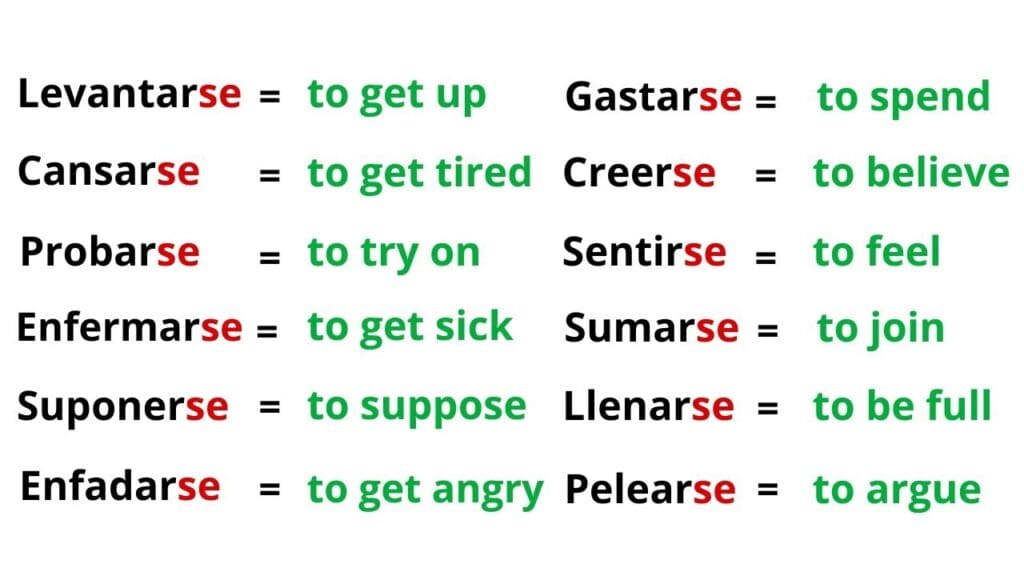
List of common Spanish reflexive verbs:
To help you along, here is a list of verbs and their meanings which are commonly used in the reflexive sense. Note that they all end with the common se.
| Verbo | ¿Qué significa? |
| Bañarse | To shower |
| Cepillarse | To brush (teeth, hair) |
| Lavarse | To wash |
| Peinarse | To comb (hair) |
| Enojarse | To get angry |
| Levantarse | To get up |
| Acostarse | To lie down |
| Despertarse | To wake up |
| Dormirse | To fall asleep |
| Cortarse | To cut |
| Llamarse | To call |
| Sentarse | To sit |
| Vestirse | To dress |
| Quitarse | To take off (clothes) |
| Ponerse | To put on (clothes) |
| Irse | To go |
Caution: A verb may be reflexive in one context, but not in another
Don’t get caught up only learning verbs as reflexive. Always think about the context in which you are using the verb.
For example: Me levanto a las 5 de la mañana - I get up at 5 in the morning. One of the key giveaways that this is a reflexive verb is the use of the pronoun me, which signifies that this is an action I do to myself. The verb that is reflexive is levantarse, which means to get up.
Yo levanto mis hijos a las 5 en mañana - I wake my children at 5 in the morning. In this instance, the verb levantar is again being used, but in this case it is not in the reflexive sense. I wake my children is something I do to them, not to myself.
You may think there are many grammar rules (which there are) and you will never learn them (but you will). The important thing to remember is that learning a language is a process that takes time and discipline. Take a look at our blog about the important factors which will determine your success.

Discover the beauty of Buenos Aires while learning Spanish at our language school. Sign up now to begin your language journey and explore this vibrant city! Click here to learn at our Spanish School in Buenos Aires
.
Also read:
Espanhol em Argentina