
• Skip to main content
  • Skip to primary sidebar
Inglés en Buenos AiresInglés en Bs. As. Inglés en Málaga Francés en CABAFrancés WhatsApp
Vamos Academy Logo
  • HOME
  • 🇦🇷 BUENOS AIRES
    Buenos Aires School

    Intensive Group Classes

    Semi-Intensive Group Classes

    Private One-On-One

    University Spanish Course

    Private Group

    Online Spanish Classes

    Register Today!

    Crash Course for Busy Travellers

    Spanish Courses for Seniors

    Classes for Kids & Families

    Evening & Weekend Classes

    Corporate Spanish Training

    VISAS AND RESIDENCY SERVICES

    Temporary Residency • Permanent Residency • Citizenship

    OTHER PROGRAMS

    English Classes

    🇩🇪 Bildungsurlaub Spanish Courses

    TEACHING COURSES

    TEFL Certification
    ELE Certification

  • 🇪🇸 MALAGA
    Malaga School

    👨‍👨‍👧‍👦Intensive Group Classes in Malaga

    👨‍👨‍👧‍👦Semi-Intensive Group in Malaga

    👩‍🏫Private One-On-One

    🧑‍🤝‍🧑Private Groups

    🏖️Spanish on the Beach

    🙋Spanish for Seniors

    Register Today!

    🚀Crash Course for Busy Travellers

    🇪🇸 Spanish Course for Expats

    👼Classes for Kids & Families

    📘Evening & Weekend Classes

    🏕️Kids Summer Camp

    MORE COURSES

    Clases de Inglés / English Classes

    Exam Preparation for DELE and SIELE

    Corporate Spanish Classes & Training

    TEFL Certification

    🇩🇪 Bildungsurlaub Spanish Courses

  • 🌐 ONLINE
  • ➕MORE
    MALAGA 🇪🇸
    ACCOMODATION & MOBILITY

    Homestay Accommodations

    Airport Transfer

    Coworking

    DAILY LIFE AT VAMOS

    Social Activities

    Flamenco Classes

    Why study Spanish in Malaga? 🔎

    BUENOS AIRES 🇦🇷
    ACCOMODATION & MOBILITY

    Homestay Accommodations

    Private Apartment

    Airport Transfer

    DAILY LIFE AT VAMOS

    Social Activities

    Tango Classes

    Why study Spanish in Buenos Aires? 🔎

    ABOUT US

    Our Málaga Team

    Our Málaga Facilities

    Our Buenos Aires Team

    Blog

    Volunteering

    CONTACT US!
  • PRICING
    BUENOS AIRES PRICES
    Smily girl
    MALAGA PRICES
    best spanish teachers in buenos aires argentina
    OUR ONLINE PRICES
    online spanish classes courses lessons
  • English
    • Türkçe (Turkish)
    • Français (French)
    • Português (Portuguese (Brazil))
Menu
×
  • Vamos Academy
  • 🏠 HOME
  • 🇦🇷 BUENOS AIRES
    • Home Buenos Aires
    • Intensive Group Classes
    • University Program
    • Private One-on-One
    • Private Group
    • Argentina Study Visa
    • TEFL Course
    • Evening & Weekend Classes
    • 1 Day Crash Course
    • Classes for Kids & Families
    • Spanish Classes
    • Study Visa and Work Visa
    • Learn Spanish in Mendoza
    • Clases de Inglés
  • 🇪🇸 MALAGA
    • Home Malaga
    • Group Classes
    • Private 1-on-1
    • Spanish Study Visas
    • Private Group
    • Spanish for Seniors
    • Kids Summer Camp
    • Spanish for Kids
    • Bildungsurlaub Course in Malaga
    • 1 Day Crash Course
    • TEFL Course
  • 🌐 ONLINE
  • 💲 PRICES
    • Pricing Buenos Aires
    • Pricing Málaga
    • Pricing Online
  • ➕ MORE
    • Argentina Study Visa
    • Spanish Students Visas
    • Accommodation
      • 🇦🇷 🏡 Homestay in Buenos Aires
      • 🇪🇸 🏡 Homestay in Málaga
      • Private Apartment in Málaga
      • Airport Transfer Buenos Aires
      • Free Coworking in Malaga
    • Community
      • Workshops & Activities
      • Volunteering in Buenos Aires
      • Tango Classes
      • Yoga Classes
      • Why Spanish in Málaga
      • Why Spanish in Argentina?
      • Our Team
    • 📖 Blog
  • 👨‍💼CORPORATE SPANISH
  • 🚀 Ready to get started?
  • 🎓 REGISTER NOW
  • 📞 CONTACT US
  • vamos spanish academy logo
  • Careers
    • Jobs in Málaga
    • Jobs in Buenos Aires
  • English
    • Türkçe (Turkish)
    • Français (French)
    • Português (Portuguese (Brazil))

Raquel Cobos

By Raquel Cobos, School Manager, Vamos Academy (Málaga & Buenos Aires)

Spain and Latin America share one language but speak it in noticeably different ways: the accent, some grammar (vosotros vs. ustedes, tú vs. vos), and hundreds of everyday words change from one side of the Atlantic to the other. Neither version is “more correct” Spanish, the Real Academia Española and the Instituto Cervantes treat every regional variety as equally valid, including on the DELE exam. Which one you should learn simply depends on where you’ll use it: European travel, EU paperwork, and exam prep point toward Spain’s Spanish, while a Latin American trip, career, or family tie points the other way.

At Vamos Academy we’re not comparing these two Spanish varieties from a textbook. We run two real campuses: one in Málaga, on Spain’s Costa del Sol, and one in Buenos Aires, Argentina, and our own teachers speak with the accents students are asking about. This guide breaks down the actual differences, city by city, so you can pick the version that matches your goals.
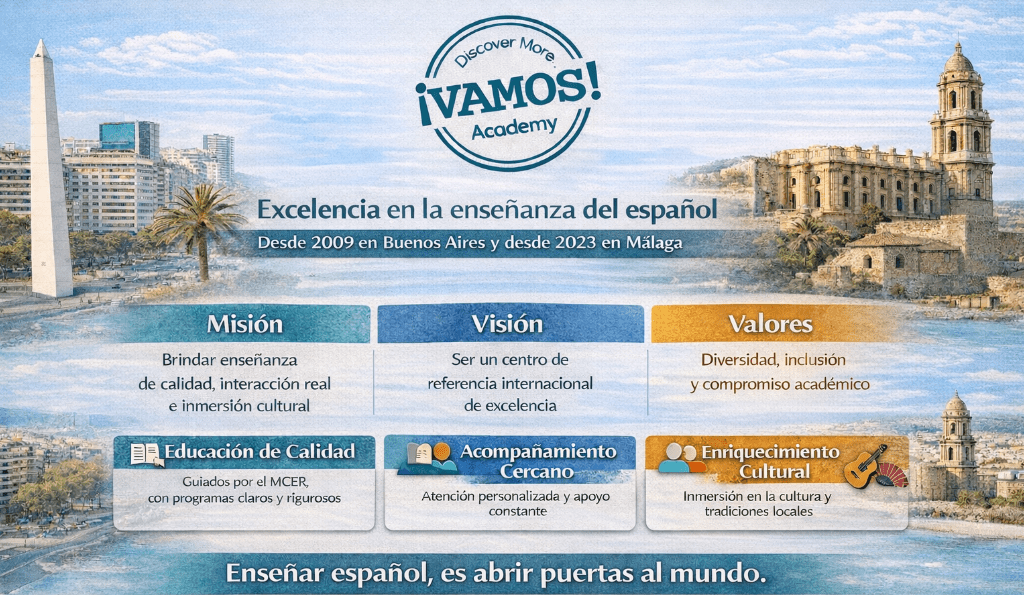
Málaga, Spain and Buenos Aires, Argentina, the two cities where Vamos Academy teaches Spanish

What Are the Real Differences Between Spain and Latin American Spanish?

The differences fall into three buckets: pronunciation, grammar, and vocabulary. None of them are large enough to stop a Spaniard and an Argentine from understanding each other, think of the gap between British and American English, but they’re large enough to notice within the first few sentences of a conversation.

It’s also worth saying upfront that “Latin American Spanish” isn’t one accent either. Mexican, Colombian, Chilean, and Argentine Spanish differ from each other almost as much as they differ from Spain’s. When people say “Latin American Spanish” they usually mean a rough, shared core, ustedes instead of vosotros, seseo pronunciation, and a common vocabulary, layered under very distinct national accents.

How Different Is the Pronunciation, and Why Doesn’t Málaga Sound Like a Madrid Newsreader?

This is the difference most people ask about first, and it’s also where competitor guides tend to oversimplify. Here’s the more accurate picture:

  • Central and northern Spain (distinción): Words with “c” (before e/i) or “z” cielo, zapato are pronounced with a soft “th” sound, distinct from “s”. This is the accent most people picture when they say “Spain Spanish.”
  • Málaga and much of Andalusia (seseo): Here’s the part most articles skip, Málaga doesn’t use that “th” distinction. The city speaks with seseo, pronouncing “c/z” the same as “s,” just like Latin America (other pockets of Andalusia go the opposite way, with ceceo), plus a fast, softened rhythm that often drops the final “s” or “d” in words. If you study in Málaga, you won’t come out sounding like a Castilian newsreader, you’ll pick up a warmer, more relaxed southern accent.
  • Latin America (seseo, plus huge regional variety): Seseo is universal across Latin America, but the accents on top of it vary enormously: the clipped clarity often associated with Mexican Spanish, the Caribbean tendency to soften or drop consonants, and Argentina’s unmistakable “sh” sound for “ll” and “y” (yo becomes something closer to “sho”).
  • Buenos Aires specifically: The Rioplatense accent has a musical, almost Italian-influenced intonation, a legacy of the massive Italian immigration of the late 19th and early 20th centuries, combined with that distinctive “sh” pronunciation and a slang vocabulary called lunfardo.

Do Spain and Latin America Use Different Grammar? (Vosotros, Ustedes, and Voseo Explained)

Grammar is where the two varieties diverge most clearly, and it comes down to two things: how “you” (plural and informal) is expressed, and which past tense people reach for by default.

Vosotros vs. ustedes

In Spain, vosotros is the everyday informal “you all” used with friends, family, classmates, while ustedes is reserved for formal or very large groups. Across Latin America, vosotros has essentially disappeared from daily speech; ustedes covers both formal and informal plural “you,” with its own verb conjugation (ustedes hablan rather than vosotros habláis).

Tú vs. vos

Most of Spain and much of Latin America use tú for informal “you.” Argentina, Uruguay, and parts of Central America instead use vos, with its own conjugation pattern: vos sos (not tú eres), vos tenés (not tú tienes), vos querés (not tú quieres). Students who learn tú first can generally still understand voseo it just takes a little exposure, which is exactly what studying in Buenos Aires provides.

Which past tense do people actually use?

Spain tends to favour the present perfect (he comido “I have eaten”) for anything that happened earlier the same day, while most of Latin America defaults to the simple past (comí “I ate”) even for very recent events. Neither is wrong; it’s a matter of everyday habit that textbooks rarely flag.

Teacher explaining tú versus vos verb conjugation on a whiteboard in a Spanish class

What Vocabulary Words Change Between Spain and Latin America?

Vocabulary is where beginners get tripped up fastest, because the words in question are everyday ones. A short reference table:

English Spain Latin America (general)
Car coche carro / auto
Computer ordenador computadora
Mobile phone móvil celular
Juice zumo jugo
Potato patata papa
To drive conducir manejar
To take/grab coger agarrar / tomar

One word deserves a warning: coger is a completely neutral verb (“to take” or “to catch”) in Spain, but in several Latin American countries, including Argentina and Mexico, it’s vulgar slang. Students moving between the two regions usually learn to swap it for agarrar or tomar once they cross the Atlantic, and it’s one of the first things our teachers flag in class.

Which Spanish Should You Learn for the DELE or SIELE Exam?

Good news if an official qualification is your goal: the Instituto Cervantes, which sets the DELE and SIELE exams, explicitly accepts all regional varieties of Spanish as equally valid for certification. You won’t lose points for using ustedes instead of vosotros, or carro instead of coche examiners are assessing whether your grammar and vocabulary are used correctly and consistently, not which region you learned from.

That said, most DELE preparation materials and exam centres in Spain are naturally built around Peninsular Spanish, so studying in-country before the exam still has practical value, you get used to the accent you’ll hear in the listening sections. Vamos Academy runs a dedicated DELE and SIELE preparation centre in Málaga, with small-group courses from €200 per week and private classes from €30 per hour, tailored to your target level and exam date.

Is Spain or Latin American Spanish Better for Travel, Work, or Family Ties?

There’s no universally “better” option, it depends entirely on why you’re learning:

  • Career and business: If your work involves the EU, Spain-based companies, or the Spanish market specifically, Peninsular Spanish and time in Spain will serve you better. If you’re aiming at Latin American trade, the US Hispanic market, or remote work with clients across the Americas, Latin American Spanish is more directly useful.
  • Travel plans: Learn the accent of wherever you’re actually going. If your itinerary is Spain and Portugal, study Spain’s Spanish; if it’s Argentina, Chile, or Mexico, lean into the regional variety you’ll hear on the ground.
  • Family or heritage: Many students are simply reconnecting with a grandparent’s or partner’s accent, in that case, the “right” Spanish is whichever one your family speaks.
  • Cost and logistics of studying abroad: Budget matters too. If Spain is the plan, it helps to know real numbers in advance, our Málaga cost-of-living guide for students breaks down monthly housing, food, and transport costs so there are no surprises once you land.
  • Longer stays in Spain: If you’re considering more than a short course, it’s worth reading up on the practical side early, our guides to the Spain student visa and the NIE number cover the paperwork you’ll eventually need.

Want to learn the Spanish that’s actually spoken on the street in Andalusia?

Study in small groups averaging 3-5 students at our Málaga campus in La Malagueta, close to the beach and the old town, with experienced, certified teachers and classes mapped to CEFR levels A1 through C2.

Explore the Málaga School

Should You Study in Málaga or Buenos Aires?

Since Vamos Academy teaches at both ends of this comparison, it’s worth laying out what each city actually offers rather than speaking in generalities.

Málaga, Spain

Our Málaga campus sits in the La Malagueta neighbourhood, close to the beach and Málaga’s historic centre. Classes average 3-5 students and are structured around CEFR levels A1-C2. As covered above, the accent here is Andalusian, softer and seseo-based, not the “Castilian lisp” many students expect. It’s also our base for DELE/SIELE exam preparation.

Buenos Aires, Argentina

Our Buenos Aires school immerses students directly in the Rioplatense accent and voseo grammar described earlier, the fastest way to get comfortable with vos sos and vos tenés is to hear them all day, every day. Course options range from intensive and semi-intensive group programmes to private one-on-one lessons, with homestay accommodation available for students who want full immersion outside the classroom too.

Can’t relocate? Study online instead

If travel isn’t an option right now, our online Spanish classes are worth a look. Group classes draw on teachers from a range of backgrounds, so you won’t choose a specific regional accent there, but private online lessons can be matched to your accent preference as much as scheduling allows, whether that’s Spain’s Spanish or a Latin American variety. Full pricing for every format, both in-person and online, is listed on our pricing page.

Small group Spanish class of four students at Vamos Academy in Málaga, Spain

Ready to start learning, wherever your Spanish takes you?

Whether you choose Málaga, Buenos Aires, or online classes, registration starts with a placement test so we can match you to the right group and accent focus.

Start Your Registration

Frequently Asked Questions

Is Latin American Spanish easier to learn than Spain’s Spanish?

Not inherently, difficulty depends more on which specific accent and grammar features you’re exposed to than on “Spain vs. Latin America” as a whole. Some learners find seseo-based accents (most of Latin America, and Andalusia in Spain) easier to parse at first than fast, consonant-dropping accents. Grammar-wise, sticking with tú instead of learning vos conjugations removes one extra pattern, but it’s a minor difference in the overall picture.

Will people in Mexico or Argentina understand Spain’s Spanish?

Yes. The differences are similar in scale to British vs. American English, accent and word choice vary, but comprehension isn’t a real barrier. The occasional vocabulary mix-up (like coger, mentioned above) is more likely to cause a laugh than genuine confusion.

Does Vamos Academy teach Spain Spanish or Latin American Spanish?

Both, depending on where you study. Our Málaga school teaches with an Andalusian accent as part of daily immersion, and our Buenos Aires school teaches with the Rioplatense accent and voseo. Online, group classes mix teacher backgrounds, while private online lessons can be matched to your preferred accent as far as possible.

Which Spanish does the DELE exam use?

None exclusively. The Instituto Cervantes accepts all regional varieties of Spanish as equally valid for the DELE and SIELE diplomas: what’s assessed is correct, consistent use of grammar and vocabulary, not which country’s accent you speak with.

Should I learn tú or vos?

Learn tú if you’re not planning to spend significant time in Argentina, Uruguay, or voseo-using parts of Central America, it’s the more widely applicable default. If Buenos Aires (or another voseo region) is your destination, it’s worth learning vos conjugations directly rather than translating from tú in your head.

Can I switch between Spain and Latin American Spanish later on?

Yes, easily. Most fluent speakers who move between regions adapt within a few weeks of immersion, swapping a handful of vocabulary words and picking up the local accent naturally. Your grammar foundation carries over regardless of which variety you started with.

Best Málaga Neighborhoods for Students & Expats

By Raquel Cobos, School Manager, Vamos Academy Málaga

The best Málaga neighborhoods for language students are La Malagueta, Soho, and the Centro Histórico/La Merced area, all within a 10-20 minute walk of the beach, the old town, and most language schools. If you’re watching your budget or staying for a full semester, El Perchel and Teatinos offer cheaper rent further from the coast, while Pedregalejo and El Palo suit students who want a slower, local pace along the eastern shoreline. Which one is “best” really comes down to how close you want to be to class and the beach, and how much you’re willing to pay for that convenience.

Aerial view of Málaga neighborhoods near the beach and old town

What Actually Makes a Neighborhood Good for a Language Student?

Before comparing areas by name, it helps to know what to weigh. Most students choosing where to live in Málaga are balancing four things:

  • Walking or cycling distance to class Málaga is compact and flat near the coast, so a 15-minute walk is normal, not a hardship.
  • Rent and housing type shared flats, homestays, and short-term studios vary a lot in price by neighborhood.
  • Safety and noise central, tourist-heavy streets are generally very safe but can be loud on weekends; residential pockets are quieter.
  • Social scene some neighborhoods are full of other international students and language learners; others are quieter, local, family-oriented streets.

With those four filters in mind, here’s how the main student-friendly neighborhoods actually compare, and it’s worth noting that most general “where to live in Málaga” guides, including our own broader locals’ guide to Málaga’s best areas, are written for expats and remote workers rather than students juggling class schedules and a language-school budget. This guide is built specifically around that second group.

Why Do So Many Language Students Choose La Malagueta?

La Malagueta is the beachside neighborhood immediately east of Málaga’s historic center, and it’s also where Vamos Academy’s Málaga school is based, on Calle Reding, a couple of minutes’ walk from the sand and a short stroll from the old town. That location is a big reason it’s the default choice for students on short or medium-length courses: you can roll out of bed, be in class in under ten minutes, and be back on the beach by early afternoon.

The area itself is residential rather than touristy: wide, palm-lined streets, a daily market feel in the mornings, and enough restaurants and gyms to cover daily life without needing to leave the neighborhood. Rent here sits at the higher end for Málaga because of the beach and the walk-to-everything location, but for students doing an intensive month or a semester who value convenience over saving on rent, it’s hard to beat.

La Malagueta beach promenade in Málaga, Spain

Want to study Spanish where you’ll actually live?

Vamos Academy’s Málaga school sits right in La Malagueta, a few minutes’ walk from the beach and the historic center, with small groups of 3-5 students so you actually get to speak. Wherever you decide to stay, class is never far away.

See the Málaga School

Is Soho Good for Students Who Want Art, Nightlife, and a Younger Crowd?

Soho sits just across the Guadalmedina riverbed from the old town, sandwiched between the port and Alameda Principal, and it’s arguably Málaga’s most visually distinctive neighborhood. Thanks to the MAUS street art project, entire building facades are covered in large-scale murals, and the area has grown into a cluster of design studios and craft bars, with the Centre Pompidou Málaga a short walk away on the Muelle Uno port promenade.

For students, the appeal is twofold: it’s roughly a 15-20 minute walk from La Malagueta and the school, and it has the youngest, most social atmosphere of any central neighborhood, useful if part of your goal is meeting other international students and practicing Spanish outside class. The trade-off is noise. Streets near the main bars can be lively well into the night on weekends, so it suits students who want that energy more than those chasing a quiet study environment.

Street art mural in Soho neighborhood, Málaga

Should You Base Yourself in the Historic Center or La Merced?

The Centro Histórico and adjoining La Merced (Picasso’s birthplace neighborhood, built around Plaza de la Merced’s gourmet market and tapas bars) are the most “postcard Málaga” places to live: cathedral, Roman theatre, and the Alcazaba fortress all within a few streets. Walking to La Malagueta from here typically takes 10-15 minutes along Paseo del Parque, a shaded, flat route that most students end up doing daily.

It’s a genuinely convenient base, but it’s also the most tourist-dense part of the city, which means higher prices for short-term rentals during peak season (spring and summer) and more foot traffic and noise around the main squares. Students on a semester-length stay often find it worth checking a few side streets back from the main plazas, where rents drop and the neighborhood feels more residential.

Are Pedregalejo and El Palo Worth the Extra Commute for Beach Life?

Head east along the coast past La Malagueta and you reach Pedregalejo, then El Palo, two former fishing villages that have been absorbed into the city without losing their village character. Both are built around a long promenade of chiringuitos (beachfront grill restaurants) serving espeto, Málaga’s classic skewered sardines, and both have a noticeably slower, more local pace than the center.

The catch is distance: it’s roughly a 35-40 minute walk from Pedregalejo to La Malagueta, though most students cover it by bike along the dedicated coastal path or by bus in 15-20 minutes. For students who prioritize an authentic, less touristy daily life and don’t mind a short commute to class, these neighborhoods are consistently popular, and generally a little cheaper than La Malagueta itself for a similar beachfront setting.

Chiringuitos on the beach in Pedregalejo, Málaga

Is Teatinos the Right Call for Budget-Conscious or Long-Term Students?

Teatinos, out on the western edge of the city, is Málaga’s university district: home to the main University of Málaga (UMA) campus, its library, sports facilities, and a large, mostly-Spanish student population. It’s consistently the cheapest neighborhood on this list for shared flats and student residences, and it has a genuine campus-town energy that La Malagueta or the center simply don’t.

The trade-off is the commute: Teatinos is well outside walking range of most language schools in the center, and getting to La Malagueta means 30 minutes or more by bus or metro each way. It makes the most sense for students combining Spanish classes with a university exchange program already based in Teatinos, or for anyone doing a long stay (a semester or longer) where the rent savings outweigh the extra travel time.

Shared Flat, Homestay, or Student Residence, Does That Change Where You Should Live?

Your housing type often narrows the neighborhood choice as much as vice versa:

  • Shared flats are easiest to find in Soho, La Merced, and Teatinos, where turnover among renters is high.
  • Homestays with local families tend to cluster in quieter residential streets: parts of La Malagueta, El Limonar, and Pedregalejo are typical.
  • Short-term studios and serviced apartments, useful for a two- to four-week intensive course, are most plentiful right in the center and La Malagueta, where owners are set up for stays shorter than a standard 12-month lease.

Whichever type you choose, budget realistically: idealista’s data from early 2026 puts the average room in a shared Málaga flat at around €435 a month, with beachfront neighborhoods like La Malagueta and Pedregalejo typically above that average and inland areas like Teatinos or El Perchel below it. For a fuller breakdown of rent, food, and transport costs by neighborhood, see our dedicated guide to the cost of living in Málaga for students, and if you’re comparing group course pricing against private lessons before booking housing, our Málaga pricing page lays out both options.

Do You Need to Register Your Address Once You Choose a Neighborhood?

If you’re staying longer than a few months, the neighborhood you pick also affects a practical step most students overlook: registering your address with the local town hall (empadronamiento) and, if required for your stay, applying for your NIE (foreigner ID number). Requirements and appointment availability shift from year to year, so rather than guessing at current fees or processing times here, we keep those details current in our step-by-step NIE and Málaga registration guide. If you’re coming from outside the EU and still working out visa paperwork before you even pick a flat, start with our Spain student visa guide Vamos Academy also provides enrolment letters for students who need one for their visa application.

One more neighborhood-adjacent tip: if part of your reason for moving to Málaga is preparing for the DELE or SIELE exam, it’s worth choosing somewhere close enough to class that you can realistically fit in extra prep sessions. Vamos Academy is a DELE and SIELE preparation centre in Málaga (a prep centre, not an exam venue), and students based in La Malagueta or the historic center tend to find it easiest to stack exam prep onto their regular course schedule without a long commute eating into study time.

Ready to pick your neighborhood and start classes?

Group courses start from €200/week with no enrollment or material fees, and private lessons start from €30/hour with no minimum commitment. Come see the school and the neighborhood for yourself.

Explore the Málaga School

So, What’s the Best Neighborhood for You?

If you’re staying a few weeks to a few months and want to walk everywhere, choose La Malagueta or the historic center. If you want a more social, artsy scene and don’t mind a slightly longer walk, Soho fits. If slower, local beach life matters more than proximity, look at Pedregalejo or El Palo. And if you’re on a tight budget or staying a full academic year, Teatinos or El Perchel will stretch your money furthest, you’ll just spend more time on the bus. For a broader, non-student-specific rundown of the city’s neighborhoods, our locals’ guide to Málaga’s best places to live and our guide to finding affordable long-term rentals in Málaga are both worth a read once you’ve narrowed things down.

Frequently Asked Questions

What is the best neighborhood in Málaga for language students?

For most short- and medium-term students, La Malagueta is the best base: it’s walkable to the beach, the historic center, and Vamos Academy’s Málaga school. If rent matters more than walking distance, El Perchel and Teatinos offer cheaper shared flats further from the coast.

Is Teatinos or La Malagueta better for student life?

Teatinos is Málaga’s university district, with the cheapest shared flats and a large student population, but it’s 30 minutes or more by bus from language schools in the center. La Malagueta costs more but puts you within walking distance of class and the beach. Choose based on whether you value savings or convenience more.

How much does student housing cost in Málaga’s best neighborhoods?

As of early 2026, the average room in a shared flat in Málaga rents for around €435 a month according to idealista, with beachfront neighborhoods like La Malagueta and Pedregalejo usually above that figure and inland areas like Teatinos or El Perchel below it. See our cost of living in Málaga guide for a full monthly budget breakdown.

Can I walk to a language school from Málaga’s city center?

Yes. From the Centro Histórico or La Merced, it’s typically a 10-15 minute walk to La Malagueta, where Vamos Academy’s school is located, along the shaded Paseo del Parque.

Do I need to register my address after choosing a neighborhood?

If you’re staying more than a few months, you’ll likely need to register your address with the local town hall (empadronamiento) and, depending on your situation, apply for an NIE. Requirements can change, so check our current NIE and Málaga registration guide rather than relying on general advice.

Which neighborhood suits a short intensive course versus a full semester?

For a two- to four-week intensive course, La Malagueta, Soho, or the historic center offer the most short-term studio and Airbnb-style options within walking distance of school. For a semester or longer, Pedregalejo, El Palo, El Perchel, and Teatinos typically offer better monthly rental value.

Opening a Spanish Bank Account as a Non-Resident in Málaga

Yes, non-residents can open a Spanish bank account: most banks in Málaga will set you up with a cuenta de no residente if you bring a valid passport, an NIE (or at least proof you’ve applied for one), and proof of address from your home country. With the paperwork in order, the whole process can take anywhere from a single appointment to a couple of weeks, the main variable is how quickly you get your non-resident certificate, which some police stations issue on the spot. Below is exactly what to bring, which banks in Málaga are worth trying first, and the mistakes that slow most people down.

Non-resident preparing documents to open a bank account in Málaga, Spain

Can Non-Residents Really Open a Bank Account in Spain?

Yes. Spanish banks have a specific product for this called a cuenta de no residente (non-resident account), designed for people who need a Spanish IBAN: to pay rent, receive a salary, or cover school fees, without being registered as tax residents. You don’t need Spanish citizenship, a job contract, or even a long-term visa to qualify. What you do need is documentation proving who you are, where you legally live, and that your funds come from a legitimate source. Banks in Málaga see a steady stream of international students, seasonal residents, and property owners, so front-line staff are generally familiar with the process, even if the paperwork itself feels bureaucratic at first.

What’s the Difference Between a Resident and Non-Resident Account?

A non-resident account is functionally similar to a standard current account: you get a debit card, an IBAN, and online banking, but it comes with a few trade-offs. Maintenance fees tend to be higher (commonly around €10-15 per month at the big traditional banks, though several waive fees for online accounts or when you meet conditions like a regular income deposit), and you’ll typically need to renew your certificado de no residente every two years to keep the account in good standing. Once you register locally (get on the padrón and pass the 183-day residency threshold), most banks will convert your account to a resident account, usually with lower fees and access to a broader range of products like credit cards or mortgages.

What Documents Do You Need to Open an Account in Málaga?

Requirements vary slightly by bank, but in practice you should arrive with:

  • A valid passport bring the original plus a photocopy of the identification pages.
  • An NIE, or proof you’ve started the process. Many banks will open a provisional account while your NIE application is pending, but they’ll usually ask you to bring the finished number within a few months. If you haven’t started yet, our step-by-step NIE guide for Málaga covers appointments, forms, and typical waiting times.
  • A certificado de no residente issued by the Policía Nacional (via form EX-15 and the tasa 790, código 012: a small fee of roughly €10, updated periodically, so check the current amount on the Policía Nacional’s electronic office when you download the form). This confirms you’re not a Spanish resident and is valid for three months from issue. Many banks can also request this certificate on your behalf for a small charge.
  • Proof of address in your home country a recent utility bill or bank statement, generally no older than three months.
  • Proof of income or purpose of stay a payslip, employment letter, pension statement, or, for students, an enrolment letter from your school confirming your course dates in Spain.

If you’re coming to Spain on a student visa rather than as a short-term visitor, it’s worth reading our Spain student visa guide first, some visa categories require proof of funds or a blocked account before the consulate will even issue the visa, which changes the order you’ll want to tackle this paperwork in.

Need paperwork before you can bank in Spain?

Vamos Academy in Málaga issues official enrolment letters that many students bring along with their passport and NIE when a bank asks for proof of why they’re in the country.

See the Málaga School

Do You Need an NIE Before You Can Open an Account?

Not always, but it makes everything faster. Legally, an NIE isn’t a strict requirement for a basic non-resident account at every bank, and some branches will open one with just a passport and the non-resident certificate. In practice, most Málaga branches either ask for it upfront or will only issue a limited, provisional account until you provide one, after which they may freeze the account if it never arrives. Since you’ll need an NIE for almost everything else in Spain anyway: signing a lease, registering for school, getting a phone contract, it’s worth applying for it as one of your very first tasks after arrival. Our NIE guide for Málaga walks through booking the Cita Previa appointment, which forms to bring, and how long the whole thing typically takes.

Which Banks in Málaga Work Best for Non-Residents?

Málaga has branches of every major Spanish bank, and the busiest ones for international clients cluster around the city centre, near Calle Larios and Alameda Principal: where staff are more accustomed to non-resident paperwork and, often, more comfortable in English. A few starting points:

  • Traditional banks such as Banco Sabadell, CaixaBank, BBVA, and Santander all offer non-resident accounts and have branch networks across Málaga. CaixaBank’s HolaBank programme, for example, is aimed specifically at international customers and doesn’t require Spanish residency, residents of a number of European countries can even open it online before arriving.
  • Digital-first options like N26, Wise, or Revolut let you get a euro IBAN online, often before you even land, availability and the country code of the IBAN depend on where you’re legally resident, which can be useful for paying a deposit or school fees in advance. They’re generally faster to set up, though they don’t fully replace a local branch account for things like cash deposits or in-person support.

It’s worth comparing at least two or three banks in person, since fees, English-language support, and how strictly each branch enforces the NIE requirement can vary noticeably even within the same city.

Bank branch in central Málaga where non-residents can open an account

Can You Open an Account Remotely, or Do You Have to Be in Málaga in Person?

Most traditional banks still require an in-person visit to a Málaga branch to open a non-resident account, mainly for identity verification. If you can’t travel yet, some banks accept a poder notarial (power of attorney) that lets someone in Spain open the account on your behalf, though this involves notary costs and paperwork of its own. Digital banks are the more practical remote option: N26, Wise, and Revolut typically verify identity through a video call or app-based ID check, so you can have an IBAN ready before you land: useful for covering a deposit, first month’s rent, or school fees in advance, even if you later open a traditional account once you’re settled.

What Problems Do Non-Residents Commonly Run Into?

A few recurring issues catch people out:

  • The non-resident certificate expires. It’s typically valid for three months, so timing matters if your bank appointment slips.
  • No local address yet. Some banks want proof of a Spanish address even for a non-resident account; a signed rental contract or your school’s accommodation confirmation can sometimes substitute.
  • Underestimating ongoing costs. Non-resident accounts carry higher monthly fees than resident accounts, and renewing your certificate every two years adds a recurring task to your calendar. If you’re budgeting your move, our cost of living guide for students in Málaga breaks down typical monthly expenses so banking fees don’t come as a surprise.
  • Foreign phone numbers. A few banks want a Spanish mobile number for SMS verification on their app, which can mean a brief chicken-and-egg problem if you haven’t set up a local SIM yet.

Studying Spanish in Málaga while you sort out the paperwork?

Small-group classes start from €200/week, with private lessons from €30/hour if you’d rather focus one-on-one, and our team can point you in the right direction with NIE appointments and local admin along the way.

View Courses in Málaga

Documents needed to open a non-resident bank account in Spain

Frequently Asked Questions

Do I need a Spanish address to open a bank account as a non-resident?

Not necessarily for the account itself, a non-resident account is designed for people without a permanent Spanish address. However, some banks ask for a temporary or rental address in Spain, especially if you’re also planning to convert the account to resident status later.

Can I open a Spanish bank account before I arrive in Málaga?

With a traditional bank, generally no, most require an in-branch visit. Digital banks like N26, Wise, or Revolut let you open an account remotely with app-based verification, which many students use to get an IBAN sorted before their flight.

How much does a non-resident account cost per month?

It varies widely by bank, some charge nothing if you meet conditions like a regular income deposit, while standard non-resident accounts at the big traditional banks commonly run around €10-15 per month. On top of that, budget for the small cost of renewing your non-resident certificate every two years. Always confirm current pricing directly with the branch, as fees and promotions change often.

What happens to my account once I become a resident?

Once you register on the local padrón and meet residency criteria, most banks will convert your non-resident account into a standard resident account, typically with lower fees and access to more products.

Is the certificado de no residente the same as an NIE?

No, they’re related but different documents. The NIE is your foreigner identification number, used for almost everything in Spain. The certificado de no residente is a separate certificate confirming your tax residency status, and it’s the one banks specifically ask for when opening a non-resident account.

Can a language school enrolment help me open a bank account?

It can help establish your purpose of stay. An official enrolment letter, the kind Vamos Academy provides to registered students in Málaga, is often accepted alongside your passport and NIE as supporting documentation, though it doesn’t replace the certificado de no residente or proof of address.

Healthcare in Spain for Expats and Students: How It Works

Spain runs a dual healthcare system: a public network, the Servicio Andaluz de Salud (SAS) here in Málaga province: that residents access once they’re registered locally, and a private system that covers most visitors, students, and newcomers before that registration comes through. If you’re arriving in Málaga to study Spanish or settle longer-term, you’ll almost certainly need private health insurance with no co-payments to get your visa approved, and then you can transition to public coverage, or simply keep private cover for faster appointments, once you’re set up here.

Public hospital in Málaga, part of the Andalusian public healthcare network

What’s the difference between Spain’s public and private healthcare systems?

Spain’s Sistema Nacional de Salud (SNS) is tax-funded and administered regionally, which is why in Málaga and the rest of Andalucía you’ll hear it called the Servicio Andaluz de Salud, or SAS. For anyone entitled to use it, mainly legal residents registered with a health card: care is free at the point of use, but it works on a gatekeeping model: you’re assigned a GP (médico de cabecera) at a local health centre, and they refer you to specialists when needed, which can mean a wait for non-urgent appointments.

Private healthcare in Spain runs alongside the public system rather than replacing it. You pay through a monthly insurance premium or directly per visit, you generally don’t need a referral to see a specialist, and appointments tend to be faster. Many expats and long-term students in Málaga end up using a mix of both: public coverage as their safety net, and private insurance or occasional private consultations for speed and English-language service. For a deeper look at how the regional system is structured, our guide to Spain’s healthcare system for expats in Andalucía breaks down the practical side in more detail.

Do you need health insurance to study Spanish in Málaga?

It depends on your nationality and how long you’re staying. If you’re a non-EU/EEA citizen enrolling in a course longer than 90 days, you’ll need a student visa, and Spanish consulates require proof of comprehensive private health insurance with no co-payments, no waiting periods, and coverage equivalent to the public system, issued by an insurer authorized to operate in Spain. This is one of the most common reasons visa applications get sent back, so it’s worth checking the fine print of any policy before you submit it. Our Spain student visa guide walks through the full application checklist, and our article on what health insurance plan you need to study in Spain goes deeper into what consulates actually look for in a policy.

If you’re staying under 90 days, a short intensive course, for example, a standard travel or student medical insurance policy is usually enough, and you won’t need to register with the local health system at all. Vamos Academy issues the enrolment letters students need for their visa paperwork, and our team can point you toward the NIE steps once you land, but we don’t sell insurance ourselves, so budget for a policy separately when you’re planning your trip.

How do EU/EEA citizens access healthcare in Málaga?

If you’re an EU, EEA, or Swiss citizen, your European Health Insurance Card (EHIC) or the UK’s GHIC post-Brexit, covers medically necessary public healthcare during a temporary stay in Málaga, at the same conditions as a Spanish resident. That’s fine for a short course, but it doesn’t cover everything: it won’t pay for repatriation, ongoing treatment for a pre-existing condition in every case, or private clinics, so many students still carry a supplementary travel policy for peace of mind.

If you’re moving to Málaga for the longer term, a full academic year, or to work after your studies, the EHIC stops being the right long-term tool. At that point you’d register as a resident, get your NIE, and either use an S1 form (if one applies to your situation) or apply for the local tarjeta sanitaria once you’re empadronado, which we cover below.

How do non-EU students and expats get covered before residency comes through?

Since you won’t have automatic access to the public system until you’re a registered resident, the private insurance you bought for your visa becomes your main coverage during your first months in Málaga. Insurers commonly accepted for Spanish visa purposes include names like Sanitas, Adeslas, DKV, and ASSSA, though requirements and approved providers can shift, so always confirm directly with your consulate or a licensed broker before buying. The two non-negotiables consulates check for are: no co-payments and coverage that matches what the public system would provide.

International student reviewing Spanish student visa and health insurance documents

Keep your policy active until you’ve either secured a route into the public system or decided to keep private cover long-term, letting it lapse between your visa approval and your residency paperwork is a common (and avoidable) gap.

How do you register for public healthcare once you’re living in Málaga?

Once you’re settled, getting into the public system generally follows this order:

1. Get empadronado. Register your address at the Ayuntamiento de Málaga (or your local town hall if you’re outside the city). This padrón certificate is the proof of residence that unlocks almost everything else, from healthcare to school enrolment.

2. Have your NIE in hand. Your foreigner identification number is required for the health card application, among nearly everything else you’ll do administratively in Spain. Our NIE guide for Málaga covers how to book the appointment and what documents to bring.

3. Apply for your tarjeta sanitaria. If you qualify for public coverage, typically through employment and social security contributions, or as a registered family member of someone who does, you apply in person at your nearest centro de salud, first-time applications can’t be completed online (the SAS online office only handles replacements). You’ll need your NIE, empadronamiento certificate, and proof of your right to coverage from the national social security institute.

4. Consider the convenio especial if you don’t qualify another way. Foreign residents who’ve been legally and continuously resident in Spain for at least a year, and who aren’t otherwise entitled to public coverage, can pay into a special agreement (convenio especial) with the public system, the base rate set by Real Decreto 576/2013 is €60 a month for those under 65 and €157 a month from 65 onwards, though regions can add supplements. It’s not automatic and it’s not a substitute for private insurance during your visa process, but it’s a useful bridge for longer-term residents who’ve fallen outside other coverage routes. Confirm the current terms with your Málaga health district before applying.

What are the best hospitals and health centers in Málaga?

For public emergency and specialist care, Málaga is served by the Hospital Regional Universitario de Málaga and the Hospital Universitario Virgen de la Victoria, both well-equipped teaching hospitals with full emergency departments (urgencias). For day-to-day, non-urgent care, you’ll be assigned to a centro de salud in your neighbourhood’s health district, Málaga is divided into a few different distritos sanitarios, so which one is yours depends on where you’re empadronado.

On the private side, Quirónsalud Málaga and Vithas Xanit International Hospital (in nearby Benalmádena) are popular with the international community, partly because staff are more likely to be comfortable working in English. If you want a fuller rundown of facilities, waiting times, and what to expect at each one, see our guide to the best hospitals in Málaga.

Studying Spanish in Málaga this year?

Vamos Academy keeps class sizes small so you actually get to speak, and our team can guide you through the enrolment letter and NIE steps that come with living here, alongside our DELE and SIELE exam prep if you’re aiming for an official certificate.

Explore Vamos Academy Málaga

What should you do in a medical emergency in Málaga?

For any serious emergency, dial 112: Spain’s EU-wide emergency number, which will connect you to ambulance, police, or fire services and can handle calls in English. You can also reach medical emergency services directly on 061. For urgent but non-life-threatening issues outside your health centre’s hours, hospital urgencias departments and after-hours “puntos de urgencia” handle walk-ins.

For minor ailments, Spanish pharmacies (farmacias, marked with an illuminated green cross) are a genuinely useful first stop, pharmacists are trained to advise on common issues and can often help without a doctor’s visit. Every neighbourhood has a rotating “farmacia de guardia” that stays open 24 hours when others are closed; the schedule is posted in pharmacy windows and online through the local pharmacists’ association.

How much does healthcare cost in Málaga for expats and students?

Once you’re in the public system as a resident, consultations, hospital stays, and emergency care are free at the point of use, and prescription medications carry a subsidized co-payment rather than the full retail price. Before that, while you’re on a visa-compliant private policy, expect to budget somewhere in the range of €40: €90 a month for a comprehensive, no-copay plan, depending on your age and the level of coverage, get a personalized quote before you commit, since exact pricing varies by provider and where you’re coming from. If you plan to pay for individual private consultations out of pocket instead, prices vary by clinic and specialty, so ask for rates up front.

It’s also worth factoring healthcare costs into your overall budget alongside rent, food, and course fees, our guide to the cost of living in Málaga for students has a fuller breakdown of what monthly life here typically costs.

Illuminated green cross pharmacy sign in Málaga city centre

Ready to sort your paperwork and start classes?

Vamos Academy walks students through enrolment and NIE steps while you study, with group Spanish courses from €200 a week and private lessons from €30 an hour, in small groups that keep you talking from day one.

Start Your Registration

Frequently Asked Questions

Do I need travel insurance if I’m an EU citizen studying in Málaga short-term?

Your EHIC covers medically necessary public care during a temporary stay, but it won’t cover repatriation, private clinics, or every situation involving a pre-existing condition. Most students still bring a supplementary travel policy for that gap, even with a valid EHIC in hand.

Can I use my home country’s private health insurance in Spain?

For everyday use, often yes. For visa purposes, only if the insurer is authorized to operate in Spain and the policy meets the consulate’s specific requirements: no co-payments, no waiting periods, and coverage equivalent to the public system. Check with your consulate before assuming an existing policy will qualify.

How long does it take to get a NIE and register for healthcare in Málaga?

It varies with appointment availability, which can be booked out for weeks through the online cita previa system. Our NIE guide for Málaga covers how to book early and what to bring so you’re not caught waiting once your course starts.

Is Spain’s public healthcare system good for expats?

Yes, Spain’s public system is consistently recognized internationally for strong outcomes and life expectancy. The main adjustment for newcomers is less about quality and more about process: getting registered, understanding the referral-based GP model, and knowing when private care is faster for non-urgent needs.

What if I’m only taking a short course, not moving long-term?

If your stay is under 90 days, you generally just need travel or student medical insurance, no NIE or padrón required for healthcare purposes. If you’d rather start with lessons remotely before deciding whether to relocate, our online Spanish classes are a low-commitment way to begin.

Does Vamos Academy provide health insurance for students?

No, we don’t sell or provide insurance directly. We issue the enrolment letters your visa application will need and can guide you through NIE and local registration steps once you arrive, but arranging a compliant health insurance policy is something you’ll need to sort with an insurer or broker before your visa appointment.

International students can complete an internship in Spain in one of two ways: as a curricular internship written into their study programme, which is covered by their existing student visa, or through Spain’s separate national internship visa (visado de prácticas), aimed at graduates and non-curricular placements. In Málaga specifically, most non-EU interns pair a short, intensive Spanish course with a placement in the city’s booming tech, tourism, or hospitality sector, since day-to-day office life, HR paperwork, and client-facing roles still run largely in Spanish. Which path applies to you depends mainly on whether you’re already enrolled in a degree programme, need a language boost first, or are applying for the standalone prácticas visa from outside Spain.

What Is an Internship in Spain for International Students, Exactly?

Spanish immigration law recognises internships (prácticas) as a distinct category from regular employment, which is why they’re handled through their own visa routes rather than a standard work permit. There are three common situations:

  • Curricular internships required by your degree programme and formalised through a convenio de prácticas between your university and the host company. These fall under your student residence permit as an academic activity.
  • Extracurricular internships optional placements taken alongside study, which still need to be compatible with your course load and registered properly.
  • Post-study internships for recent graduates using a contrato de prácticas, applied for on Spain’s dedicated internship visa rather than a study visa.
International student interning at a Málaga tech company

Do You Need a Special Visa to Intern in Spain as a Non-EU Student?

If you’re a non-EU/EEA citizen, yes, unless the internship is curricular and already covered by a student visa you hold for a different purpose (such as attending an accredited Spanish course). Spain’s internship visa is a national long-stay (Type D) visa with two routes: an internship agreement (convenio de prácticas), where the residence authorisation matches the agreement’s length up to a maximum of 12 months, or a training contract (contrato de prácticas), where it matches the contract’s duration under Spanish labour law. Either authorisation can be extended once, to a maximum of 2 years in total, under Real Decreto 1155/2024, and both routes are aimed at people who obtained a higher-education qualification within the previous two years or are enrolled in studies leading to one. Separately, a Social Security reform in force since 1 January 2024 made enrolment mandatory for every intern in Spain, paid or unpaid, so you’ll need a Social Security number before your placement can start. Rules and processing times shift, so always confirm current details with the Spanish consulate handling your file, or read our Spain student visa guide before you apply.

Need your paperwork sorted before you land in Málaga?

Vamos Academy issues the enrolment letters Spanish consulates ask for and guides new arrivals through the NIE process, so your student or internship visa file is ready before you even touch down.

Explore the Málaga Spanish School

Can You Do an Internship in Spain While Already on a Student Visa?

Often, yes. If your internship is curricular, a formal requirement of the degree you’re enrolled in, it generally doesn’t need a separate work authorisation, because it’s treated as part of your academic activity rather than employment. Beyond that, non-EU students holding a Spanish study permit for higher-education studies can work (including in compatible internships) up to 30 hours per week without applying for a distinct work permit, a right built into Real Decreto 1155/2024, though it doesn’t extend to permits issued for language courses alone. Either way, you’ll still need an NIE: the foreigner identification number every employer, university, and bank in Spain will ask for: before payroll, Social Security, or even an unpaid internship agreement can be processed. Our NIE in Málaga guide and our related piece on work permit rules for student-visa holders both walk through the practical steps.

Why Is Málaga a Smart Base for an International Internship?

Unlike Madrid or Barcelona, Málaga combines a genuine, fast-growing employer base with a city small enough to navigate without a daily commute eating your afternoon. Málaga TechPark alone now hosts more than 700 technology companies and multinationals: including Oracle, Ericsson, Vodafone, Accenture, and TDK: many of which take on interns across software, cybersecurity, data, and marketing roles, while Google runs its European cybersecurity engineering centre (GSEC) near the port in the city centre. Outside the TechPark, the Costa del Sol’s year-round tourism and hospitality industry regularly hires interns for guest relations, events, and marketing placements, which tends to demand stronger everyday Spanish than a corporate tech office would. Between the two sectors, Málaga offers a rare mix: internationally minded employers alongside plenty of chances to actually practise Spanish outside working hours, in a city where the cost of living is noticeably lower than Spain’s two biggest cities.

Where Can You Find an Internship in Málaga as a Foreign Student?

Most international students line up a Málaga internship through one of four routes: their home university’s exchange or careers office (needed for a convenio de prácticas), a Spanish university or private placement programme that partners with local employers, direct outreach to companies based at Málaga TechPark or along the Costa del Sol hospitality corridor, or specialist study-and-work-abroad providers that combine a Spanish course with a guaranteed placement. Whichever route you choose, arriving with even conversational Spanish makes a measurable difference: not just for interviews, but for the everyday logistics of opening a bank account, dealing with your landlord, or registering with a doctor once you’re here.

Interns networking near Málaga TechPark offices

What Does It Cost to Live in Málaga During an Internship?

Most students in Málaga spend between €850 and €1,200 a month excluding tuition or course fees, though a disciplined budget in a shared flat can bring that down to €700, €800. A room in a shared apartment typically runs €300: €500 (less in areas like La Victoria or El Ejido, more in the historic centre), groceries cost roughly €150: €250 a month if you cook at home, and a subsidised monthly youth bus pass (under-30 rate, with discounts currently extended through 2026) is around €13.50. That figure matters because it’s usually well above the minimum financial proof required for a student visa, commonly cited as around €600 a month (100% of the IPREM) so budget for real living costs, not just the visa threshold, especially if your internship is unpaid. Our full cost-of-living breakdown for Málaga students covers rent, transport, and food in more detail.

How Much Spanish Do You Need Before You Start an Internship in Málaga?

Plenty of Málaga TechPark roles run in English day to day, but almost every internship still involves Spanish somewhere: team lunches, HR forms, a landlord’s WhatsApp messages, or a tourism-facing role where guests expect at least basic conversation. A short intensive course before your placement starts, or evening classes running alongside it, is the standard fix. Vamos Academy runs small group Spanish courses in Málaga starting from €200 a week, plus private lessons from €30 an hour if you need a flexible schedule around internship hours. If you can commit to studying before you arrive, the school’s online Spanish classes are a practical way to reach a working level early. For students who want a certificate to strengthen an internship or graduate-job application afterwards, Vamos Academy also offers DELE and SIELE exam preparation in Málaga, see our DELE exam guide for how the preparation courses work. Registration for any course takes just a few minutes online.

Ready to add real Spanish fluency to your internship CV?

Join a small group class from €200 a week or book private lessons from €30 an hour with Vamos Academy in Málaga, including DELE and SIELE exam preparation.

Start Learning in Málaga

Small group Spanish class at Vamos Academy Málaga

Frequently Asked Questions

Do international students need a special visa to intern in Spain?

Non-EU students usually do, unless the internship is curricular and already covered by an existing student visa. Spain’s dedicated internship visa (visado de prácticas) covers both students on a university convenio de prácticas and graduates on a contrato de prácticas. EU/EEA citizens don’t need a visa for an internship in Spain.

How many hours can I legally work or intern per week on a Spanish student visa?

Under Real Decreto 1155/2024, non-EU students holding a study permit for higher-education studies can work, including in compatible internships, up to 30 hours a week without a separate work authorisation, as long as it doesn’t interfere with their studies. This right doesn’t extend to permits issued for language courses alone.

Do I need an NIE before starting an internship in Málaga?

Yes. Your NIE (foreigner identification number) is required before an employer or university can register you for Social Security, run payroll, or formalise even an unpaid internship agreement. Apply for it as soon as you arrive, see our NIE in Málaga guide.

Is Málaga a good city for a tech internship compared to Madrid or Barcelona?

Yes. Málaga TechPark hosts more than 700 technology companies, including Oracle, Ericsson, Vodafone, and Accenture, and Google runs its European cybersecurity engineering centre in the city centre, giving interns access to major employers in a smaller, cheaper, and more walkable city than Madrid or Barcelona.

Do unpaid internships in Spain need a work permit?

They don’t need a standard work permit, but since January 2024 all internships in Spain regulated by an internship agreement, paid or unpaid, must be registered for Social Security contributions, which requires a Social Security number.

How much Spanish should I know before interning in Málaga?

There’s no fixed legal requirement, but a conversational level (roughly B1) makes daily life and many roles far easier, especially outside international tech offices. An intensive course before your placement, such as small-group or private classes with Vamos Academy, is the most common way students reach that level quickly.

Empadronamiento in Málaga: Why You Need It & How to Register

Empadronamiento in Málaga is the process of registering your address with the Ayuntamiento de Málaga (city council) on the local población register, or padrón municipal. If you’re an international student, remote worker, or new resident, you’ll almost certainly need it to apply for a NIE, access public healthcare, renew a student visa, or enrol children in school. Registration is done in person at one of Málaga’s OMAC offices, usually with a booked appointment, and it costs nothing.

OMAC office in Málaga where residents complete empadronamiento

What Is Empadronamiento and Why Does It Matter in Málaga?

Empadronarse means adding your name and address to the padrón municipal de habitantes, the official register the Ayuntamiento de Málaga keeps of everyone living within city limits. It isn’t the same as residency or a visa: it’s a local administrative record that proves, on paper, that you actually live at a specific address in the city. The Ayuntamiento uses this data to plan public services, allocate school places, and fund healthcare centres, which is why the padrón carries real weight with other government offices.

For anyone moving to Málaga to study, work remotely, or settle longer-term, the certificado de empadronamiento (the certificate proving you’re registered) tends to come up almost immediately, often before you’ve even finished unpacking. Spanish bureaucracy runs on documents that reference each other, and this one is frequently the first domino in a longer chain of paperwork.

Who Actually Needs to Register on Málaga’s Padrón?

In practice, most foreign residents in Málaga need to empadronarse fairly early on. This typically includes:

  • International students staying longer than a few months, especially those applying for or renewing a student visa
  • Anyone booking an appointment to obtain a NIE (Número de Identidad de Extranjero), since many extranjería offices ask for proof of local address
  • Families enrolling children in Málaga’s public or subsidised schools
  • Non-EU nationals accessing the Andalusian public healthcare system
  • EU citizens registering to vote in Spanish municipal elections
  • Anyone applying for local discounts, such as reduced public transport fares

If you’re only in Málaga for a short language course of a few weeks, you may not need to register at all. But if you’re staying for a term, a semester, or longer, which is common among students preparing for a DELE exam in Málaga it’s worth doing early rather than scrambling for it when an extranjería appointment suddenly requires it.

What Documents Do You Need to Empadronarte in Málaga?

The Ayuntamiento de Málaga asks for two categories of documents: proof of who you are, and proof of where you live.

Identification one of the following:

  • Valid passport (for those without a NIE yet)
  • NIE certificate or TIE (residence card), if you already have one
  • DNI, for Spanish nationals

Proof of address this depends on your housing situation:

  • If you’re the tenant: your signed rental contract
  • If you’re living with a host family, flatmate, or friend who holds the lease: a signed authorisation from the person on the contract, plus a copy of their ID
  • If you own the property: the escritura (title deed) or a recent property tax (IBI) receipt
  • A recent utility bill is sometimes accepted as supporting evidence alongside the above

You’ll also need to complete the hoja padronal, the official registration form, which is available at the OMAC office or downloadable in advance from the Ayuntamiento’s website. Bring both originals and photocopies of everything, Spanish administrative offices routinely ask for both, and staff generally will not photocopy documents for you on site.

Documents needed for empadronamiento in Málaga: passport, NIE, and rental contract

Sorting out empadronamiento while still learning the vocabulary for it?

Vamos Academy’s Spanish school in Málaga runs small-group classes and private lessons, so you can build the practical Spanish you need for OMAC appointments, NIE forms, and everyday admin, while settling into life in the city.

Explore Our Málaga Spanish School

Where Are Málaga’s OMAC Offices Located?

Empadronamiento is handled at the OMAC (Oficinas Municipales de Atención a la Ciudadanía), Málaga’s network of citizen service points, eleven offices in total, one for each municipal district:

  • OMAC Centro Calle La Merced, 1, in the historic centre
  • Ten further district offices covering Málaga Este, Ciudad Jardín, Bailén-Miraflores, Palma-Palmilla, Cruz de Humilladero, Carretera de Cádiz, Churriana, Campanillas, Puerto de la Torre, and Teatinos-Universidad

Padrón paperwork is also handled at the citizen service desk of Gestrisam (Gestión Tributaria), the municipal tax agency, at Avenida Sor Teresa Prat, 17 (Edificio Tabacalera).

Because most students and new arrivals live closer to the centre or the university area, OMAC Centro and the Teatinos-Universidad office tend to be the most convenient options. Whichever office you choose, you can complete the padrón there, registration isn’t restricted to the office nearest your new address.

How Do You Book a Cita Previa for the Padrón in Málaga?

Appointments (cita previa) are required for OMAC service, with one notable exception: people over 65 can generally be attended without booking ahead. Everyone else should reserve a slot before turning up, since staff won’t process registration without one.

You can book a cita previa in two ways:

  • Online, through the Ayuntamiento’s appointment platform at citaprevia.malaga.eu, where you select the service (padrón/empadronamiento), an office, and an available time slot
  • By phone, calling the municipal information line on 010 (or 951 926 010 if calling from outside Málaga)

OMAC offices attend the public Monday to Friday from 9:00 to 14:00, excluding public holidays and 24 and 31 December. Appointment slots can fill up quickly, especially in September and October when the academic year begins and many students arrive in Málaga at once, so it’s worth booking as soon as you have your documents ready rather than waiting until the week you need the certificate.

Booking a cita previa online for empadronamiento in Málaga

How Long Does Empadronamiento Take, and Is There a Fee?

Registering on the padrón in Málaga does not cost anything, there’s no fee to submit the hoja padronal or to request your certificado de empadronamiento afterwards. The in-person appointment itself is usually quick once your documents are in order, though processing your entry into the register and issuing the certificate can take anywhere from the same day to a couple of weeks, depending on the office’s workload at the time. If you need the certificate urgently, for example, ahead of a NIE appointment with a fixed date, it’s worth mentioning this to staff when you attend, and asking whether an immediate printed certificate is possible.

What Can You Do With Your Certificado de Empadronamiento?

Once you’re on the padrón, you can request a certificado de empadronamiento, the document that proves your registered address in Málaga. This certificate is commonly required for:

  • Booking or completing a NIE application at the Comisaría or extranjería office
  • Registering with Andalusia’s public healthcare system and getting a tarjeta sanitaria
  • Renewing a student visa or applying for a change of status while in Spain
  • Enrolling children in local schools
  • Opening some Spanish bank accounts, alongside your NIE or passport
  • Applying for local resident discounts, such as reduced-rate public transport cards

Many procedures ask for a “reciente” (recently issued) certificate, three months from the issue date is the cutoff most institutions apply in practice, so it’s worth checking the specific requirement of the office you’re dealing with before requesting yours, rather than assuming an old copy will do.

What Mistakes Do International Students Often Make With Empadronamiento?

A few recurring issues can slow the process down:

  • Arriving without an appointment. OMAC staff generally cannot process walk-ins outside the over-65 exemption, so turning up without a cita previa usually means leaving and rebooking.
  • Missing the landlord’s authorisation. If you’re not named on the rental contract, common for students in shared flats or with host families, you need a signed permission letter from the person who is, plus their ID copy. Without it, the application can be rejected outright.
  • Assuming it replaces a visa or NIE application. Empadronamiento is a supporting document, not a substitute for immigration paperwork. It typically needs to be paired with other steps, including the process covered in our NIE guide for Málaga.
  • Waiting until the last minute. Appointment availability tightens considerably around the start of academic terms, so booking early avoids unnecessary delays to visa or healthcare paperwork.

If budgeting for these early admin steps alongside rent and course fees feels like a lot to plan for, our guide to the cost of living in Málaga for students breaks down what to expect beyond tuition.

Ready to make Málaga home?

Enrol in a group or private Spanish course with Vamos Academy and receive an enrolment letter to support your NIE, padrón, and visa paperwork from day one, taught by a small, dedicated team based right here in Málaga.

Start Your Registration

Frequently Asked Questions About Empadronamiento in Málaga

Is empadronamiento the same as getting residency in Spain?

No. Empadronamiento only registers your address with the local council; it does not grant or affect your immigration status. It’s a supporting document used alongside, not instead of: visa, NIE, or residency procedures.

Can I register in Málaga without a rental contract in my name?

Yes, but you’ll need a signed authorisation from the person who is on the lease or property deed, along with a copy of their ID. This is common for students sharing a flat or staying with a host family.

Do I need a NIE before I can empadronarme in Málaga?

Not necessarily. Many people register using their passport before they have a NIE, since empadronamiento is often a step taken before applying for one. Requirements can vary slightly by office, so confirm what identification you’ll need when booking your cita previa.

Is there a fee to register or get a certificate?

No. Registering on the padrón and requesting your certificado de empadronamiento are both free through the Ayuntamiento de Málaga.

How do I book an appointment for empadronamiento in Málaga?

Book online at citaprevia.malaga.eu or by calling 010 (951 926 010 from outside Málaga). People over 65 are generally exempt from needing an appointment.

How long does the certificate stay valid?

The certificate itself has no fixed expiry date, but most institutions only accept one issued within the last three months. Since the exact window depends on the office requesting it, check their requirement before ordering your copy.

Written by Raquel Cobos, School Manager at Vamos Academy Málaga.

  • Page 1
  • Page 2
  • Page 3
  • Interim pages omitted …
  • Page 7
  • Go to Next Page »

Primary Sidebar

  • English
    • Türkçe(Turkish)
    • Français(French)
    • Português(Portuguese (Brazil))
  • This field is for validation purposes and should be left unchanged.
  • LET'S GET STARTED!

    By going through this quick form, we can help land you on the best class to fit your needs and requirements. Let's start by learning a little bit more about you.

    Note: We do not share or sell any information you submit to us to third-parties. By providing us with your information, we will only add you to our marketing list, which you will be given the option to opt out of.

  • An intensive course can be designed for you by combining group classes in the morning and supplementary private classes in the afternoon.

    Click below to learn more about these classes:

This site is protected by reCAPTCHA and the Google Privacy Policy and Terms of Service apply.

Vamos Academy.

Spanish and English, taught by our own teachers in the classroom and live online.

Talk to us

Málaga 18 links

Calle Reding 6, 29016 Málaga
+34 951 120 697
View on Google Maps ↗

Courses in Málaga

  • Intensive group
  • Semi-intensive group
  • Private one-on-one
  • Private groups
  • Spanish on the beach
  • Spanish for seniors
  • Crash course
  • Spanish for expats
  • Kids and families
  • Evening and weekend
  • Kids summer camp
  • Teens and juniors
  • High school program

The school and the city

  • Activities in Málaga
  • Why Málaga
  • Our Málaga team
  • Homestay in Málaga
Buenos Aires 14 links

Maipú 464, C1084 Buenos Aires
+54 9 11 3782-8084
View on Google Maps ↗

Courses in Buenos Aires

  • Group classes
  • Private one-on-one
  • Private Spanish group
  • Evening and weekend
  • Crash course
  • Kids and families
  • Teens and juniors
  • High school program

The school and the city

  • Activities in Buenos Aires
  • Volunteering
  • Why Buenos Aires
  • Our Buenos Aires team
  • Homestay in Buenos Aires
Legal services in Spain 10 links

Visas, residency and paperwork for students and expats, handled by our own team in Málaga.

All legal services in Spain

Visas for Spain

  • Student visa
  • Non lucrative visa
  • Digital nomad visa

Residency and paperwork

  • NIE number
  • TIE card
  • Arraigo
  • Empadronamiento
  • Spanish citizenship
  • Immigration lawyer in Málaga
Our other schools 14 links

Vamos schools beyond our two main campuses.

North America

  • Toronto
  • Ottawa
  • Montreal
  • Milwaukee
  • Sacramento
  • Miami

United Kingdom

  • London
  • Birmingham
  • Manchester

Latin America

  • Santiago de Chile
  • Peru
  • Mexico
  • Colombia
  • Montevideo
Online

Live classes with our own teachers, from wherever you are.

  • Online Spanish classes
  • Toll free +1 888 808 1242
Other languages

English and French, taught the Vamos way.

  • Inglés en Buenos Aires
  • Inglés en Málaga
  • Francés en Buenos Aires
Visas for Argentina

Study and work visa support for your time in Argentina.

  • Argentina study and work visas
About Vamos 4 links

Who we are and how we work.

  • How we teach
  • Our mission
  • Our vision
  • For agencies and partners
Student services 5 links

Everything around your course, before and during your stay.

  • Private apartment
  • Airport transfer
  • Free Spanish resources
  • Blog
  • Contact us
Careers 5 links

Teach with us, in person or online.

  • Careers at Vamos
  • Jobs in Buenos Aires
  • Jobs in Málaga
  • Online and remote jobs
  • Teaching jobs
Follow Vamos 13 links

Each school posts its own day to day.

Málaga

  • TripAdvisor ↗
  • Facebook
  • Instagram
  • X
  • LinkedIn

Buenos Aires

  • TripAdvisor ↗
  • Facebook
  • Instagram
  • X
  • LinkedIn

Both schools

  • YouTube
  • TikTok
  • Pinterest

© 2026 Vamos Academy. Spanish and English language school.

Legal information Terms and conditions Cookie policy GDPR
Manage Consent
To provide the best experiences, we use technologies like cookies to store and/or access device information. Consenting to these technologies will allow us to process data such as browsing behavior or unique IDs on this site. Not consenting or withdrawing consent, may adversely affect certain features and functions.
Functional Always active
The technical storage or access is strictly necessary for the legitimate purpose of enabling the use of a specific service explicitly requested by the subscriber or user, or for the sole purpose of carrying out the transmission of a communication over an electronic communications network.
Preferences
The technical storage or access is necessary for the legitimate purpose of storing preferences that are not requested by the subscriber or user.
Statistics
The technical storage or access that is used exclusively for statistical purposes. The technical storage or access that is used exclusively for anonymous statistical purposes. Without a subpoena, voluntary compliance on the part of your Internet Service Provider, or additional records from a third party, information stored or retrieved for this purpose alone cannot usually be used to identify you.
Marketing
The technical storage or access is required to create user profiles to send advertising, or to track the user on a website or across several websites for similar marketing purposes.
  • Manage options
  • Manage services
  • Manage {vendor_count} vendors
  • Read more about these purposes
View preferences
  • {title}
  • {title}
  • {title}
Manage Consent
To provide the best experiences, we use technologies like cookies to store and/or access device information. Consenting to these technologies will allow us to process data such as browsing behavior or unique IDs on this site. Not consenting or withdrawing consent, may adversely affect certain features and functions.
Functional Always active
The technical storage or access is strictly necessary for the legitimate purpose of enabling the use of a specific service explicitly requested by the subscriber or user, or for the sole purpose of carrying out the transmission of a communication over an electronic communications network.
Preferences
The technical storage or access is necessary for the legitimate purpose of storing preferences that are not requested by the subscriber or user.
Statistics
The technical storage or access that is used exclusively for statistical purposes. The technical storage or access that is used exclusively for anonymous statistical purposes. Without a subpoena, voluntary compliance on the part of your Internet Service Provider, or additional records from a third party, information stored or retrieved for this purpose alone cannot usually be used to identify you.
Marketing
The technical storage or access is required to create user profiles to send advertising, or to track the user on a website or across several websites for similar marketing purposes.
  • Manage options
  • Manage services
  • Manage {vendor_count} vendors
  • Read more about these purposes
View preferences
  • {title}
  • {title}
  • {title}
  • Vamos Academy
  • 🏠 HOME
  • 🇦🇷 BUENOS AIRES
    • Home Buenos Aires
    • Intensive Group Classes
    • University Program
    • Private One-on-One
    • Private Group
    • Argentina Study Visa
    • TEFL Course
    • Evening & Weekend Classes
    • 1 Day Crash Course
    • Classes for Kids & Families
    • Spanish Classes
    • Study Visa and Work Visa
    • Learn Spanish in Mendoza
    • Clases de Inglés
  • 🇪🇸 MALAGA
    • Home Malaga
    • Group Classes
    • Private 1-on-1
    • Spanish Study Visas
    • Private Group
    • Spanish for Seniors
    • Kids Summer Camp
    • Spanish for Kids
    • Bildungsurlaub Course in Malaga
    • 1 Day Crash Course
    • TEFL Course
  • 🌐 ONLINE
  • 💲 PRICES
    • Pricing Buenos Aires
    • Pricing Málaga
    • Pricing Online
  • ➕ MORE
    • Argentina Study Visa
    • Spanish Students Visas
    • Accommodation
      • 🇦🇷 🏡 Homestay in Buenos Aires
      • 🇪🇸 🏡 Homestay in Málaga
      • Private Apartment in Málaga
      • Airport Transfer Buenos Aires
      • Free Coworking in Malaga
    • Community
      • Workshops & Activities
      • Volunteering in Buenos Aires
      • Tango Classes
      • Yoga Classes
      • Why Spanish in Málaga
      • Why Spanish in Argentina?
      • Our Team
    • 📖 Blog
  • 👨‍💼CORPORATE SPANISH
  • 🚀 Ready to get started?
  • 🎓 REGISTER NOW
  • 📞 CONTACT US
  • vamos spanish academy logo
  • Careers
    • Jobs in Málaga
    • Jobs in Buenos Aires
  • English
    • Türkçe (Turkish)
    • Français (French)
    • Português (Portuguese (Brazil))
  • English
  • Türkçe (Turkish)
  • Français (French)
  • Português (Portuguese (Brazil))