





Quick answer
Pionono is a rolled sponge cake that began in Granada, Spain in 1897. In Spain it is still a small individual dessert, a syrup soaked sponge with a torched cream top. In Argentina it became a full size sheet filled with mayonnaise, ham and vegetables, served at Christmas.
Pionono (pee-oh-NOH-noh) is a rolled sponge cake that started as a single sweet pastry in Granada, Spain in 1897 and split into two very different foods once it crossed the Atlantic. In Spain it’s still a small, individual-size dessert, a syrup-soaked sponge with a torched cream top, sold by the box as piononos. In Argentina it became a full-size sponge sheet that Buenos Aires families fill with mayonnaise, ham, and vegetables and serve as the centerpiece of their (very hot, very summery) Christmas dinner. Both are called pionono. Here’s how to tell them apart, what’s actually inside each one, and how to make the Argentine version yourself.
In this article
What Is Pionono, Exactly?
At its simplest, pionono is a thin sheet of sponge cake rolled around a filling. That’s the entire definition, everything else depends on which country you’re in. The name itself is a clue: it comes from “Pío Nono,” the Italian nickname for Pope Pius IX, who in 1854 proclaimed the dogma of the Immaculate Conception. A pastry chef named Ceferino Isla, devoted to the Virgin Mary, wanted to honor the pope for that proclamation, and from 1897 he sold his creation at his shop, Casa Ysla, on Calle Real in the small town of Santa Fe, in the province of Granada: a cylindrical, syrup-soaked sponge filled with cream and crowned with a torched cream top, its rounded, chubby shape meant to echo the papal figure. Because Santa Fe sits in Andalusia, the Spanish original is often described as an Andalusian pastry, a pionono andaluz, and that recipe is where every pionono in the world, sweet or savory, Argentine or Spanish, traces its name.
Quick facts:
Born: Santa Fe, Granada, Spain, 1897, by pastry chef Ceferino Isla
Named for: Pope Pius IX (“Pío Nono” in Italian)
Also known as: pionono andaluz (Spain), pionono argentino (Argentina)
Arrived in Argentina: most likely the early 1900s, with Spanish immigration
Became in Argentina: a savory Christmas dish, alongside its original sweet form
Is Pionono Argentine or Spanish?
Both, honestly. It just means different things depending on where you order it. The pastry was invented in Spain, but it’s very likely that Spanish immigrants carried the recipe to Argentina in the early twentieth century, the same way they brought so much else that’s now considered classic Argentine cooking. Once it landed in Buenos Aires, the dish took on a life of its own: Argentines kept the sweet, dulce-de-leche-filled version as an everyday dessert, but they also built an entirely new savory tradition around it, something the original Granada pastry never became. So when someone searches “pionono argentino” versus “pionono español,” they’re really asking about two branches of the same family tree, not a spelling difference.
In Argentina, Christmas falls in the middle of summer. There’s no snow, no fireplace, no mulled wine, just heat, backyard pools, and long, late dinners eaten with the windows open. That’s exactly why the savory pionono exists: it’s a no-cook (or barely-cook) dish built for a hot night, the Argentine answer to a Christmas table that has to work in December highs averaging around 29°C (84°F) instead of near freezing.
What’s the Difference Between Argentine and Spanish Pionono?
The clearest way to see it is side by side. The Spanish original is a small individual pastry you’d order with coffee; the Argentine versions are full sheet cakes meant to be sliced and shared at the table.
| Spanish Pionono (Granada) | Argentine Sweet Pionono | Argentine Savory Pionono | |
|---|---|---|---|
| Format | Small individual pastry, a few centimeters tall | Full sponge sheet, rolled and sliced | Full sponge sheet, rolled and sliced |
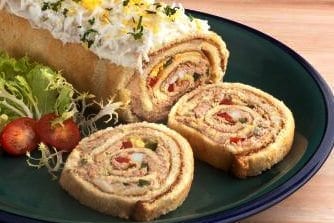
| Filling/topping | Syrup-soaked sponge with cream inside, torched cream and a dusting of cinnamon on top | Dulce de leche, sometimes with fruit or whipped cream | Mayonnaise, ham, lettuce, hard-boiled egg, tomato, red pepper, olives (or tuna, or ham and hearts of palm) |
| When it’s eaten | Any time, as a coffee-shop treat | Any time, as a dessert | Christmas Eve and New Year’s Eve dinners, birthdays, gatherings |
| Where to find it | Pastry shops in Santa Fe and greater Granada, Andalusia | Confiterías and supermarkets across Argentina | Confiterías (pre-made) or homemade, across Argentina, especially Buenos Aires |

What’s Inside a Savory Pionono? (Pionono Primavera and More)
The most popular version is the pionono primavera (“spring pionono”), spread with mayonnaise and layered with lettuce, hard-boiled egg, ham, tomato, red pepper, and olives, sometimes swapping tuna in for the ham. A close second is a simpler combination of mayonnaise, ham, and hearts of palm, which shows up constantly in Argentine summer salads and appetizers too. Because more than one filling is usually on the table at once, families rarely settle on just one version. Modern takes have pushed the format further, with fillings like blue cheese, shredded chicken, canned tuna, or even a sweet-and-salty pineapple-and-ham combination, proof that the format itself, a soft rolled sheet, is really just a blank canvas. It also travels well: because it’s rolled tight and sliced cold, a pionono holds up on a buffet table for hours without drying out, which is part of why it shows up at birthdays and office parties as often as it does at Christmas dinner.
Tip for anyone cooking in Buenos Aires: you don’t have to bake the sponge from scratch. Pre-made pionono sheets are sold in the bakery aisle of most Argentine supermarkets, ready to fill and roll, the same shortcut most local households actually use. Shopping for one is also a genuinely useful way to practice Spanish: the packaging, the cooking shows, and the people behind the counter all use the same everyday vocabulary you need for any Argentine supermarket run.
How Do You Make Pionono at Home?
The sponge itself is a simple, egg-heavy batter that bakes in one thin sheet, which is what makes it flexible enough to roll without cracking.
- Preheat the oven to about 400°F (200°C) and line a rimmed baking sheet with parchment paper, lightly greased.
- Beat 4 large eggs with 40g caster sugar and 40g honey on high speed for 8-10 minutes, until pale, thick, and roughly tripled in volume.
- Gently fold in 55g of sifted flour by hand, a little at a time, so the batter keeps its air.
- Spread the batter evenly and thinly across the prepared sheet: this is what determines whether it rolls cleanly later.
- Bake for about 10 minutes, just until set and lightly golden; a thin sponge overbakes fast, so watch it closely.
- Let it cool slightly, then spread your filling (dulce de leche for sweet, mayonnaise-based for savory), and roll it up like a log while it’s still pliable. Chill briefly, then slice into rounds about 1-2 cm thick to serve. One sheet makes roughly 8 servings.
For the sweet version, Vamos has a full homemade dulce de leche recipe that pairs perfectly with a fresh pionono sheet.
Why Do Argentines Eat Pionono at Christmas If It’s Summer?
Because a heavy, hot dish doesn’t make sense at a midnight dinner in 30°C heat. Savory pionono is served cold or at room temperature, needs almost no last-minute cooking, and can be made hours ahead, all of which matters when the meal starts late and the night is humid. It sits alongside other cold, shareable dishes on the Argentine Christmas table, more like a picnic spread than a formal dinner. If you want the full rundown of what else shows up on that table, Vamos has a guide to celebrating Christmas in Buenos Aires, and if you’re curious about the other iconic Argentine baked good, there’s also a full breakdown of Argentine facturas.
Want to actually cook (and order) this like a local?
Vamos Academy has a Spanish school in Buenos Aires, with small group classes and private lessons, so you can learn the language in the city where the savory pionono, the confitería counter, and the late summer Christmas dinner are all part of everyday life.
FREE RESOURCES
Free Spanish study pack
Printable study sheets from our teachers, plus one short email a week.
One email, then a short weekly tip. Unsubscribe any time.

Where Does the Name “Pionono” Come From?
It’s a direct tribute to a real pope. Pius IX’s name in Italian is “Pio Nono,” and Ceferino Isla named his 1897 creation after him out of personal devotion, a small edible tribute to the pope who had proclaimed the dogma of the Immaculate Conception in 1854. He shaped the cake’s silhouette, a short rounded cylinder topped with pale cream, to echo the papal figure. The tribute apparently worked: in 1916, the Duke of San Pedro de Galatino reportedly served the pastry to King Alfonso XIII at his estate near Granada, and the king was said to be impressed enough to grant Casa Ysla the title of official supplier to the Spanish Royal Household. The name stuck so well that it eventually traveled with the pastry itself, first around Spain and then across the Atlantic, staying attached to the dish even as Argentine cooks reinvented what actually went inside it.
Curious about the Spanish original?
Granada, home of the first pionono, is roughly an hour and a half by road from Vamos Academy’s Spanish school in Málaga: an easy day trip once you’re studying on the coast. Come learn Spanish in Andalusia, in small groups and with DELE and SIELE exam prep available, and taste the pastry that started it all.
Frequently Asked Questions About Pionono
What is pionono?
Pionono is a thin sponge cake rolled around a filling. In Spain it’s a small individual pastry with caramelized cream on top; in Argentina it’s a full sheet cake filled with either dulce de leche (sweet) or mayonnaise, ham, and vegetables (savory).
Is pionono from Argentina or Spain?
Spain, originally. It was created in 1897 in Santa Fe, Granada, and most likely reached Argentina with Spanish immigrants in the early 1900s. Argentina then developed its own savory version, which isn’t part of the Spanish tradition.
What’s the difference between Argentine pionono and the pionono from Granada?
The Granada original is a small individual pastry with custard cream and a torched sugar top, eaten any time as a treat. The Argentine version is a full sponge sheet, most famously filled savory (mayonnaise, ham, vegetables) and served at Christmas, though a sweet, dulce-de-leche version also exists as an everyday dessert.
What is pionono primavera?
It’s the most popular savory version: a pionono sheet spread with mayonnaise and layered with lettuce, hard-boiled egg, ham, tomato, red pepper, and olives. A common variant swaps in tuna for the ham.
Can pionono be a dessert (postre pionono)?
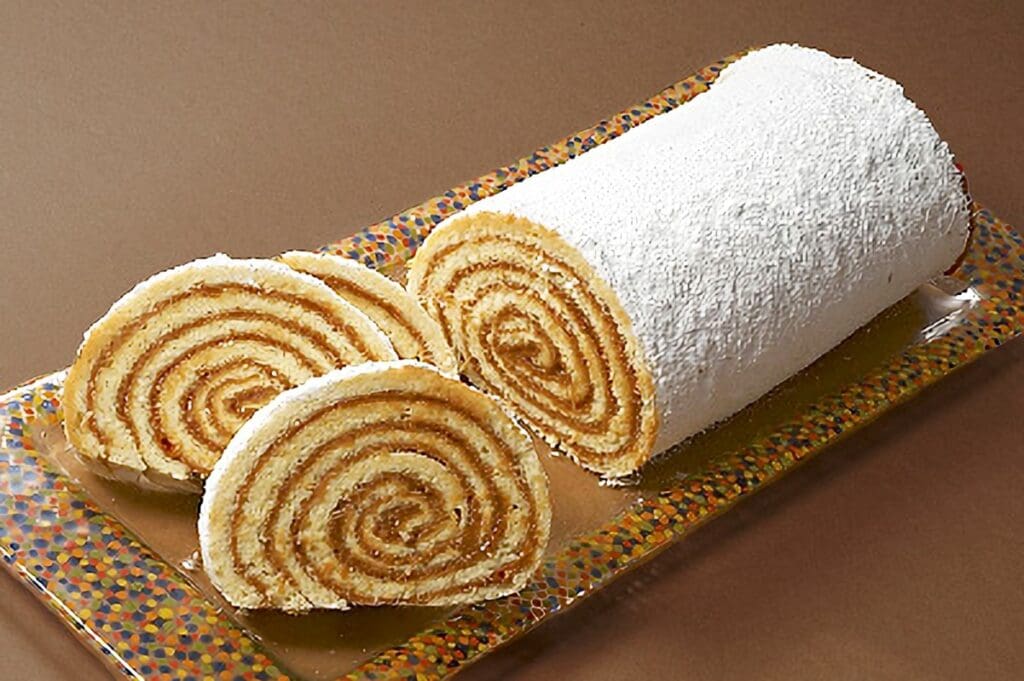
Yes. That’s actually its original form. The sweet, dessert version is rolled with a generous layer of dulce de leche and often finished with confectioner’s sugar, chocolate, or cherries. It’s sold and eaten year-round, separately from the Christmas savory tradition.
Where does the name “pionono” come from?
From Pope Pius IX, whose name in Italian was rendered “Pio Nono.” Pastry chef Ceferino Isla named his 1897 Granada creation after the pope as a tribute to the 1854 proclamation of the dogma of the Immaculate Conception, shaping the cake’s rounded, cylindrical silhouette to echo the papal figure.
Is “pianono” the same as pionono?
If you’re searching in Spanish, yes, “pianono,” along with “pinono,” “piononi,” and “pio nono,” are all common misspellings or spacings of pionono, the same rolled sponge cake described above. The plural in Spanish is piononos. (The Philippines does have a separate dessert genuinely called pianono: a small rolled sponge filled with butter and sugar. It shares the papal namesake but is not the Argentine or Spanish dish.)
How do you pronounce pionono?
Pee-oh-NOH-noh, with the stress on the third syllable, the same way you’d read the Spanish spelling “pionono” phonetically. There’s no silent letter and no unusual sound; each vowel is pronounced clearly and separately.
Test yourself
Quick quiz
Quick quiz: pionono
0 of 5 answered